Issues
Every decision a School Board makes should ultimately answer one question:
Will this help students learn and succeed?
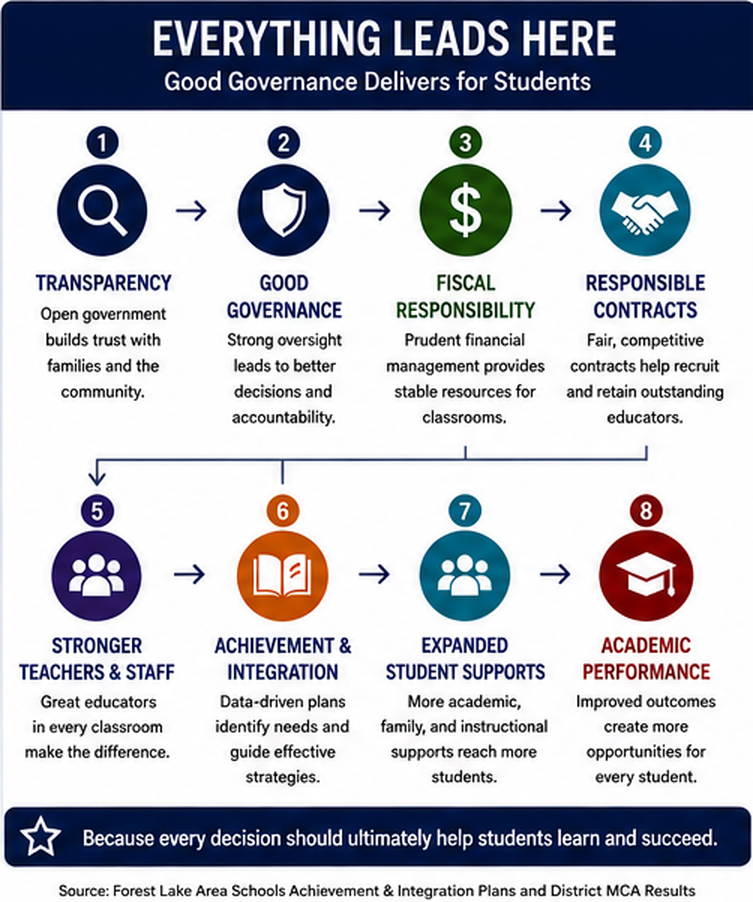
Financial responsibility matters because it provides stable resources for classrooms. Responsible contract negotiations matter because they help recruit and retain outstanding teachers and staff. Transparency matters because it builds trust with families. Strong governance matters because it helps the district make better decisions.
Academic performance is how we measure whether those decisions are actually working.
Academic Performance Is the Measure of Our Mission
Public education exists to prepare students for successful lives. Every budget decision, employee contract, academic investment, facility improvement, and policy adopted by the School Board should ultimately improve opportunities for students.
Academic performance is not the only measure of student success, but it is one of the clearest ways to evaluate whether the systems we have built are helping students learn, grow, and prepare for what comes next.
Good school boards do not teach reading, mathematics, or science. Teachers do. Administrators build instructional programs. The Board's responsibility is different: establish clear goals, provide adequate resources, measure outcomes, and hold the organization accountable for results. When those responsibilities are carried out effectively, educators are better positioned to help students succeed.
Using Data to Improve Academic Performance
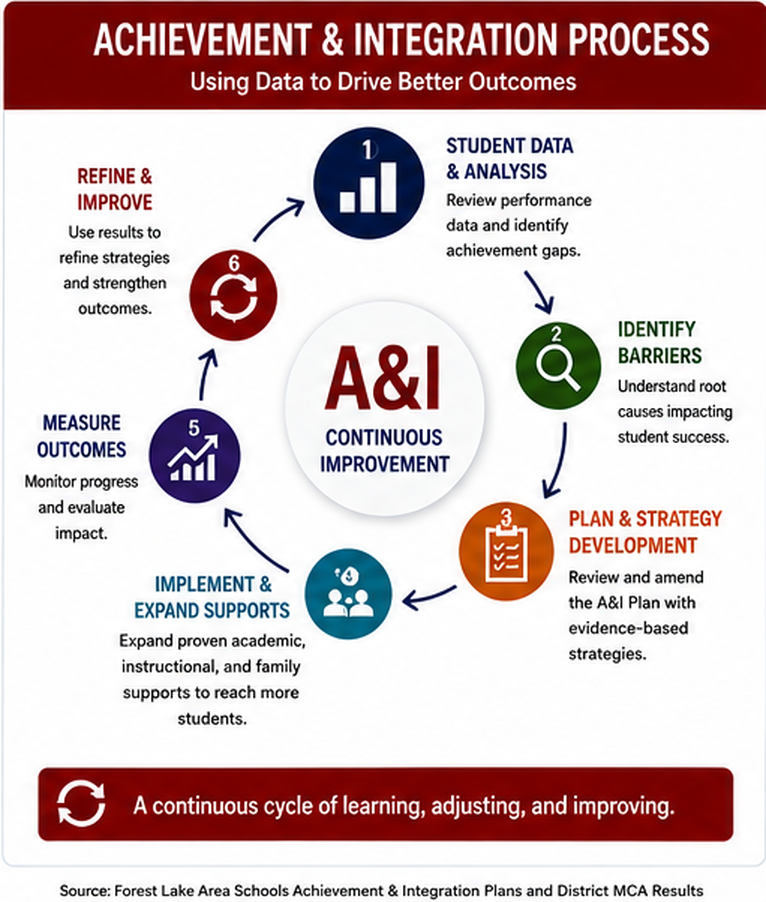
During my tenure on the Board, we focused not only on measuring academic performance, but on understanding why some students were succeeding while others continued to face persistent barriers. That required looking beyond a single test score and examining how district systems, academic supports, family engagement, attendance, and access to rigorous opportunities affected student outcomes.
A significant part of this work occurred through Minnesota's official Achievement & Integration (A&I) program. The program requires eligible districts to identify measurable achievement disparities, adopt strategies to address those disparities, and regularly evaluate whether those strategies are improving outcomes.
The district's 2023-2026 Achievement & Integration Plan established measurable goals and strategies intended to improve academic performance and reduce identified disparities. As Board President, I worked with district administration to ensure that the annual review examined whether those strategies were reaching the students facing the greatest barriers and whether the available evidence supported a different approach.
Improving the Achievement & Integration Plan
Through deeper analysis of student performance data, the district identified that economic disparities were strongly associated with academic outcomes. That finding challenged us to examine whether existing strategies were reaching the students facing the greatest barriers and whether successful supports could be made available to more students.
At the same time, the district was redesigning sixth-grade service delivery. That transition created an opportunity to reconsider how student supports were delivered throughout the district. I worked with the administration to ensure that the broader review incorporated the achievement data and informed the annual A&I review, resulting in the 2025 amended Achievement & Integration Plan.
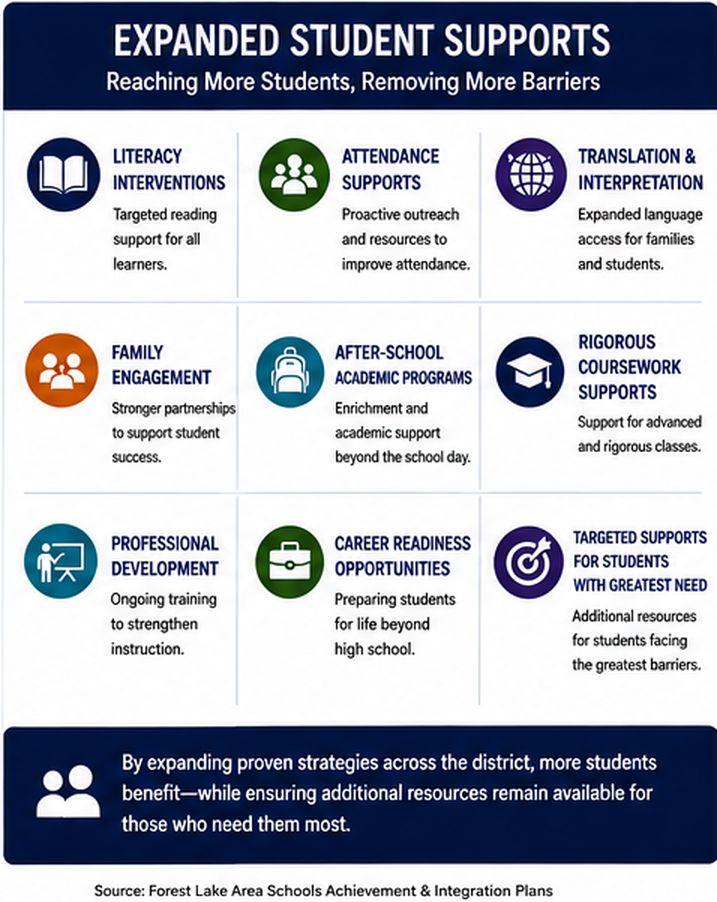
The amended plan represented a major strategic shift. Rather than concentrating additional services primarily around demographic categories, it expanded support based on demonstrated student need. Students facing the greatest barriers continued to receive targeted assistance, while more students gained access to academic, instructional, and family supports already shown to help remove barriers to success.
In practical terms, the amended plan broadened access to literacy interventions, attendance supports, family engagement, translation and interpretation services, after-school academic opportunities, rigorous coursework supports, career readiness programming, and professional development for educators. The goal was not to eliminate targeted assistance, but to make successful strategies available to more students while preserving additional resources for those facing the greatest barriers.
Measuring Academic Performance
Academic performance should be measured by outcomes, not intentions. Forest Lake Area Schools uses multiple measures to evaluate student learning and growth, including the Minnesota Comprehensive Assessments (MCA), FastBridge assessments, ACT, SAT, PSAT, Advanced Placement results, attendance, graduation, and college and career readiness.
No single test tells the entire story. Each measure provides another piece of the picture and helps families, educators, administrators, and the Board understand where students are succeeding and where continued improvement is needed.
Early Results: The Numbers Tell the Story
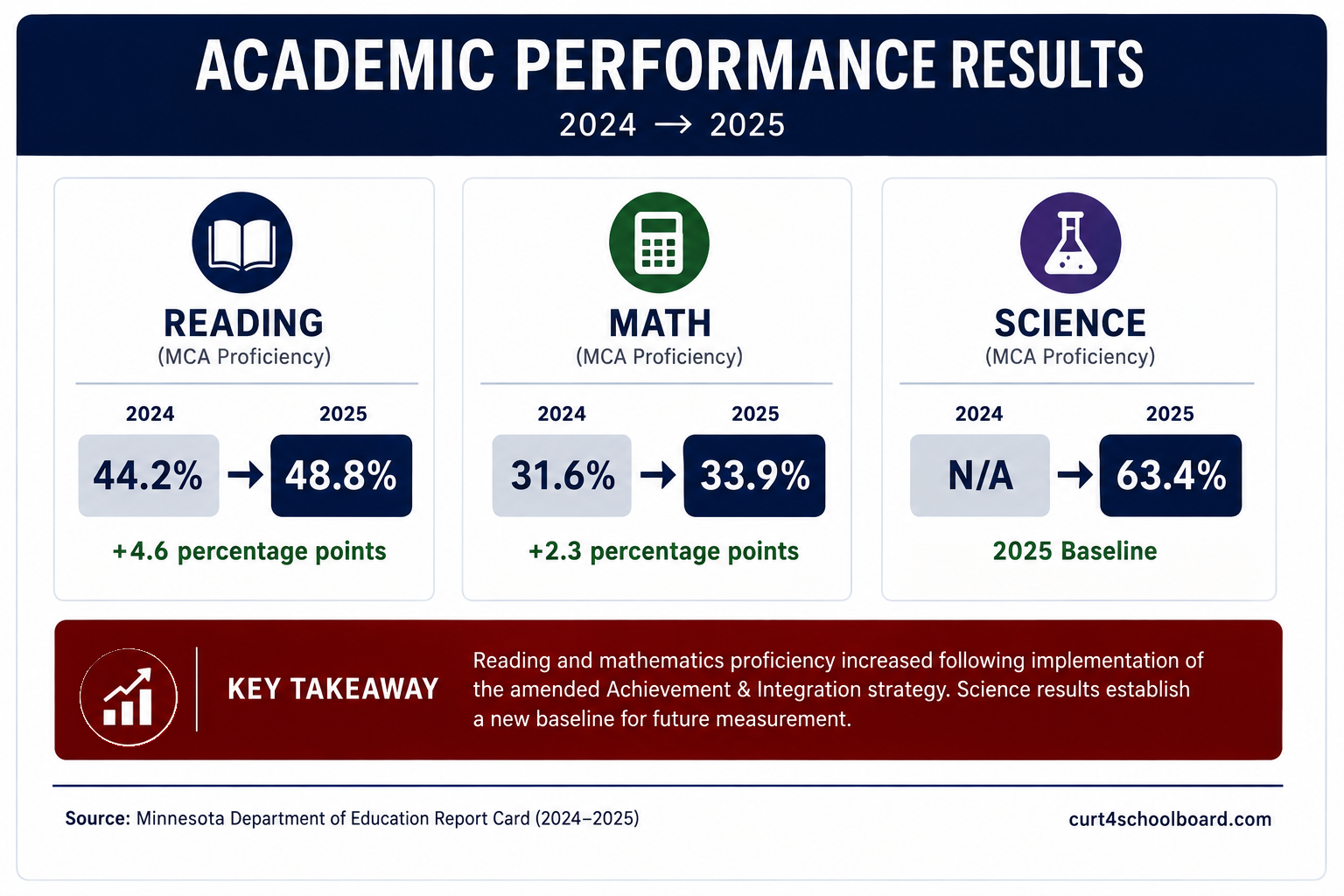
Meaningful changes in academic performance typically take time. Forest Lake had participated in Achievement & Integration planning for more than a decade, yet many gaps remained persistent. Following the 2025 amendments and the expansion of student supports, measurable improvement appeared during the next school year.
| Measure | 2024 | 2025 | Change |
|---|---|---|---|
| Reading Proficiency | 44.2% | 48.8% | +4.6 percentage points |
| Math Proficiency | 31.6% | 33.9% | +2.3 percentage points |
| Science Proficiency | N/A | 63.4% | 2025 baseline |
Source: Minnesota Department of Education Report Card
Student achievement is influenced by many factors, and no single initiative or individual deserves sole credit. One responsibility of the School Board, however, is to ensure that decisions are guided by evidence rather than assumptions. When measurable improvement follows thoughtful changes in strategy, it reinforces the value of continuing to evaluate results, expand what is working, and refine the District's approach where additional improvement is needed.
Continuous Improvement, Not a Victory Lap
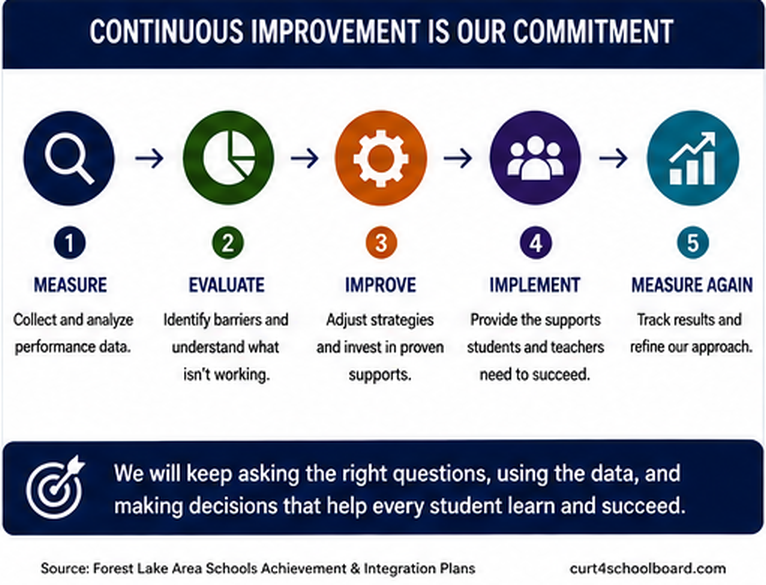
Early progress is encouraging, but it is not the same as completing the work. Academic performance requires continued measurement, honest evaluation, and a willingness to refine strategies over time.
Because the amended strategies showed promising early results, the District's adopted 2026-2029 Achievement & Integration Plan continues many of the strategic priorities established through the 2025 amendments. This reflects a deliberate decision to build on approaches that showed encouraging early results while continuing to evaluate outcomes, refine supports, and adjust strategy based on student performance.
Why Every Other Issue Matters
Fiscal responsibility, responsible contracts, transparent governance, and strong oversight are not separate priorities. They are the systems that allow a school district to support educators, invest in students, and improve outcomes.
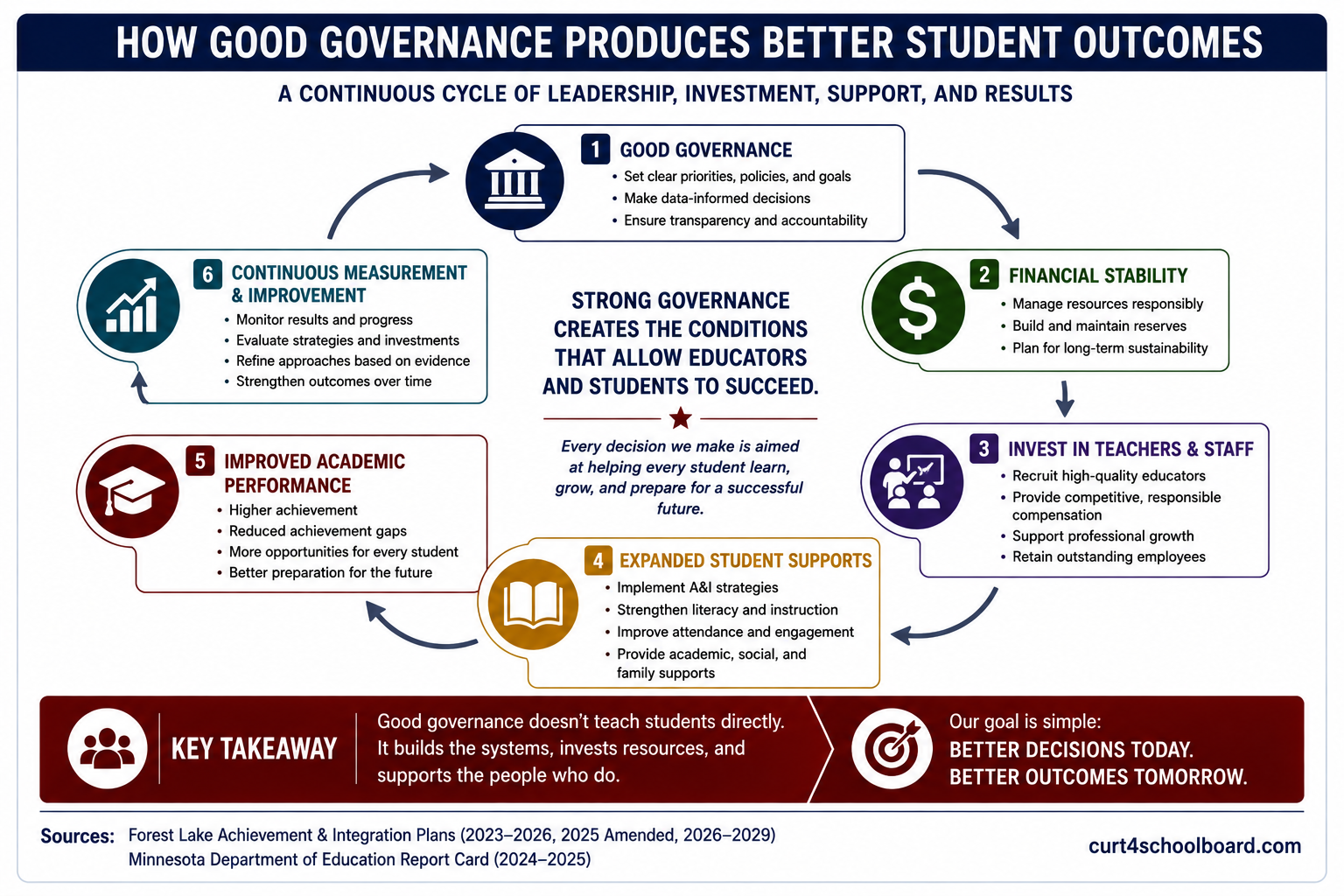
Every issue on this website ultimately points to the same objective. Responsible governance builds financial stability. Financial stability allows the District to invest in outstanding teachers and staff. Outstanding employees provide better opportunities and stronger support for students. Academic performance helps us measure whether those decisions are producing better outcomes.
How Good Governance Produces Better Student Outcomes
Strong academic performance does not begin with a test score. It begins with responsible governance, stable finances, investment in outstanding teachers and staff, and student support systems designed around demonstrated need. Those decisions create better learning opportunities, and better opportunities create better outcomes.
Review the Evidence
I encourage residents to review the underlying plans and performance data for themselves. These documents show the goals, strategies, amendments, and measurable results discussed on this page.
- 2023-2026 Achievement & Integration Plan
- 2025 Amended Achievement & Integration Plan
- 2026-2029 Achievement & Integration Plan
- Minnesota Department of Education Report Card
Academic performance is not improved by slogans or good intentions. It improves when leaders establish clear goals, measure results, learn from the data, make thoughtful adjustments, and remain focused on what matters most: helping every student succeed. That is the approach I have taken throughout my service on the School Board, and it is the approach I will continue to bring if entrusted with another term.
I believe elected officials should lead by taking action, documenting their work, and allowing the public to judge the results for themselves.
Documented Leadership on Title IX
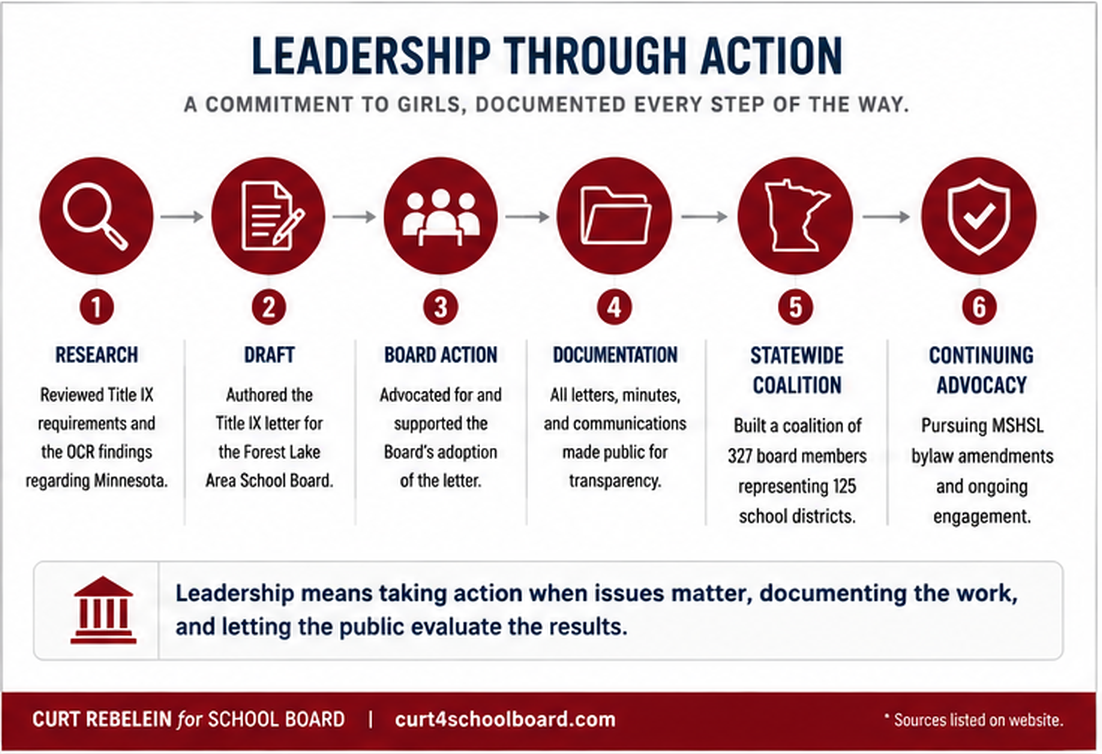
Protecting equal athletic opportunities for girls under Title IX is an issue where I chose to lead through action rather than simply comment. I researched the issue, put my position in writing, brought it before the Board, made the supporting documentation public, and continued working through established statewide governance processes.
| Action | Result | Public Evidence |
|---|---|---|
| Authored Forest Lake Title IX letter | Formally adopted by the Forest Lake Area School Board | Executed letter and recorded Board meeting |
| Statewide coalition effort | 327 school board members from 125 districts | TitleIXMN.com and statewide media coverage |
| Advanced MSHSL bylaw amendments | Formal supporting letters submitted through the MSHSL process | Proposed amendment and supporting correspondence |
| Documented every step | Residents can evaluate the complete public record | Letters, findings, video, proposal, coalition, and news coverage |
Leadership Through Action
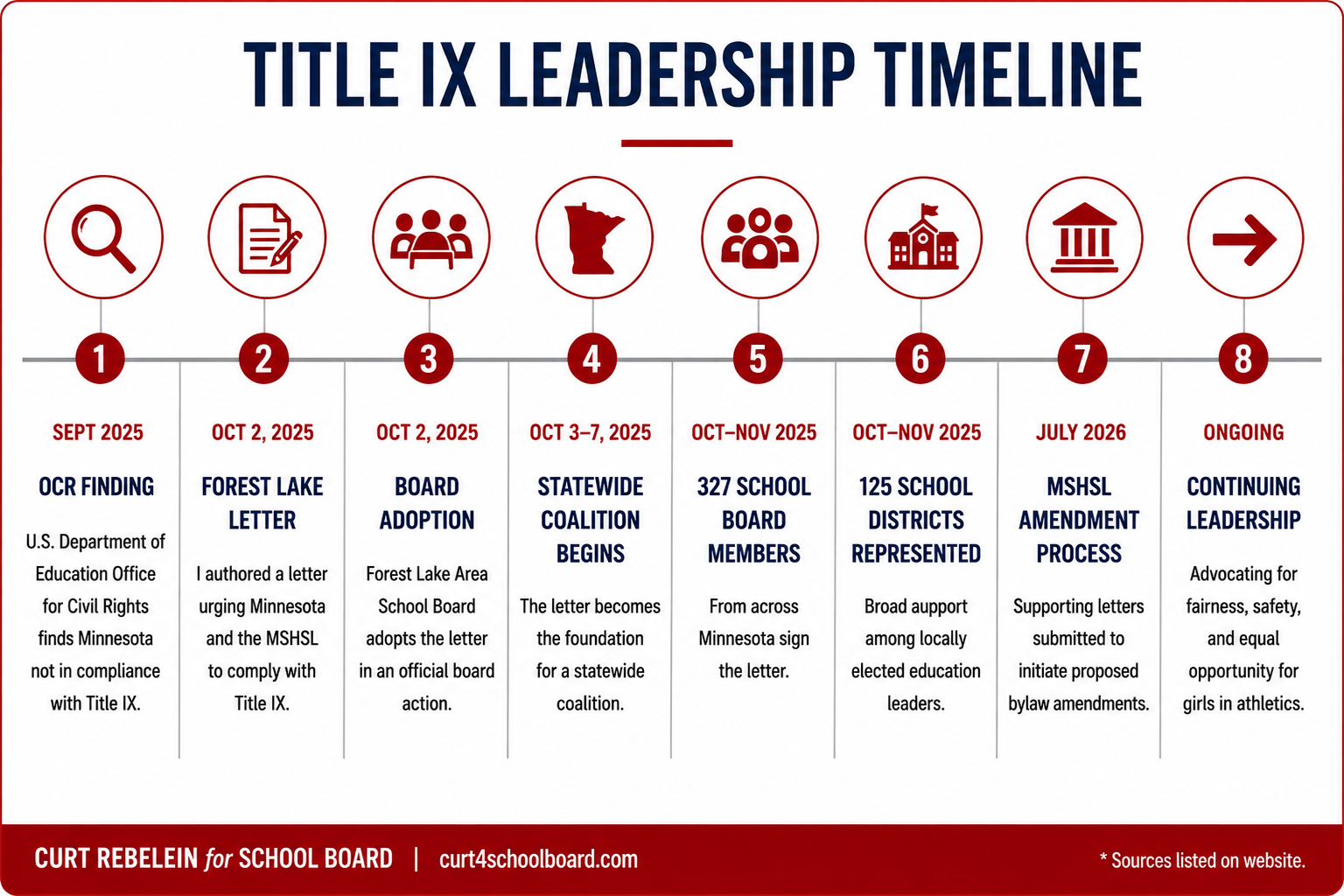
In October 2025, I authored a letter urging the Minnesota Department of Education and the Minnesota State High School League to comply with federal Title IX requirements protecting girls' athletics following the Office for Civil Rights' finding that Minnesota was not complying with Title IX and its notice that continued noncompliance could place federal education funding at risk.
The Forest Lake Area School Board formally adopted that letter, making our district the only school board in Minnesota to take an official action on the issue. The Board's discussion and adoption of the letter remain available in the October 2, 2025, Board meeting recording.
While I advocated for the Board to take action and supported adoption of the October 2025 Title IX letter, not every member of the Board supported that action. The public record, including Board proceedings, public statements, and documented positions, provides residents with an opportunity to evaluate the priorities, decisions, and leadership approaches of every candidate seeking to serve on the School Board. The public record allows voters to compare not only what candidates say during an election, but also what they did when they had the opportunity to lead.
From Forest Lake to a Statewide Coalition
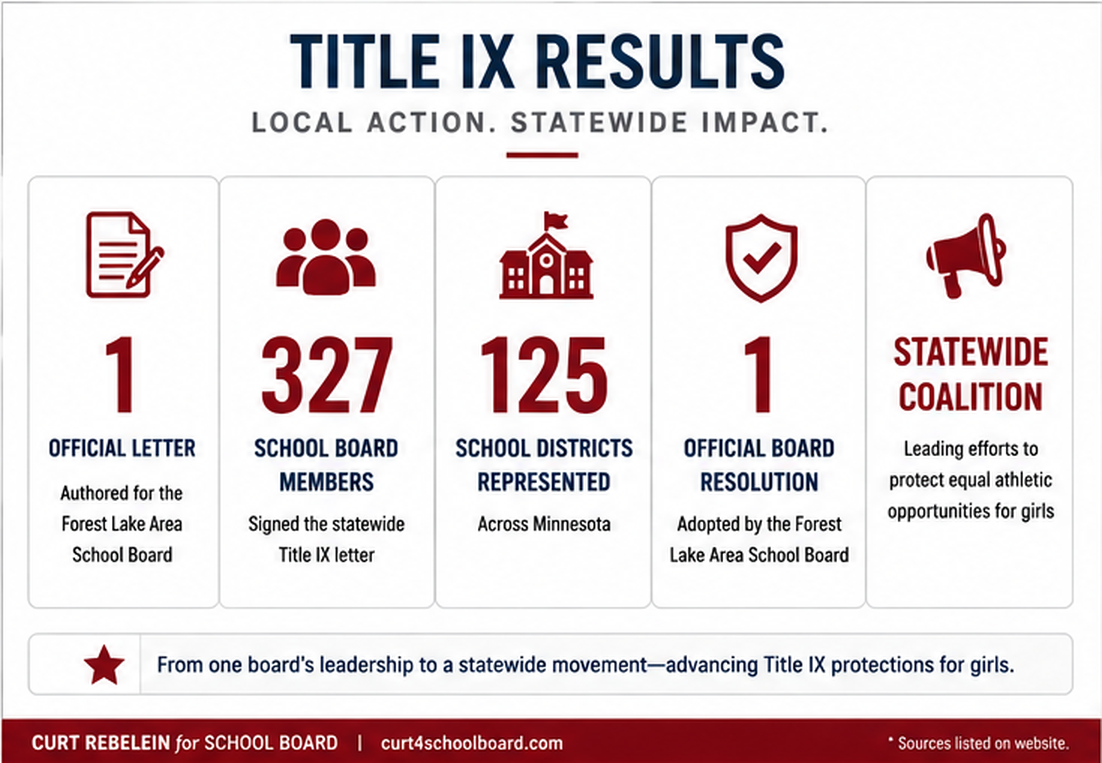
What began as a single Board action in Forest Lake quickly grew into a statewide effort. The letter I authored for the Forest Lake Area School Board became the foundation for a coalition of elected school board members. 327 school board members representing 125 school districts ultimately signed the letter through TitleIXMN.com, demonstrating broad support among locally elected education leaders for preserving equal athletic opportunities for girls.
Continuing Through the MSHSL Process
After the initial Title IX letter, I continued pursuing action through the MSHSL process. As one of the five school board members required under MSHSL bylaws to initiate consideration of a proposed amendment, I authored the supporting letters submitted to the Minnesota State High School League and to our district's Activities Director, who serves on the MSHSL Board of Directors.
I also support the Make It Fair Minnesota initiative, which helps educate the public about the proposed amendments and builds awareness as the formal MSHSL amendment process moves forward.
Why This Matters
School boards are responsible for responding when significant legal, regulatory, or policy questions affect students, athletics, district operations, or public funding. Whether residents ultimately agree or disagree with a particular position, they deserve leadership that is thoughtful, documented, transparent, and accountable.
The Public Record
Every major claim on this page is supported by a public document, recorded meeting, external coalition record, or statewide news report.
- Forest Lake Board Title IX Letter
- Office for Civil Rights Findings and Notice
- October 2, 2025, Board Meeting Discussion and Vote
- Statewide Title IX Coalition
- Proposed MSHSL Bylaw Amendment and Supporting Reasoning
- Letter to the Minnesota State High School League
- Letter to the Forest Lake Activities Director
Statewide News Coverage
The Forest Lake School Board's action and the statewide coalition it inspired received statewide media attention as additional school board members joined the effort.
- Forest Lake School Board urges Minnesota, State High School League to comply with federal transgender athlete policy - Star Tribune (October 3, 2025)
- More school board members urge Minnesota to comply with federal transgender athlete policy - Star Tribune (October 7, 2025)
- Funding fears drive push to reverse Minnesota transgender athlete policy - Star Tribune (October 8, 2025)
My Approach to Leadership
Public service should be measured by documented actions, not campaign slogans. When I take a position, I put it in writing, present it publicly, work through the proper governance process, and make the supporting documents available so every resident can evaluate the facts and reach their own conclusion.
Leadership Through Safety & Security
Safe and secure schools are the foundation that allows teachers to teach and students to learn. Over the past several years, Forest Lake Area Schools have made significant progress in improving the safety of our facilities, strengthening security practices, and creating safer learning environments. The hard work already completed should be recognized, while continuing to look for opportunities to improve.
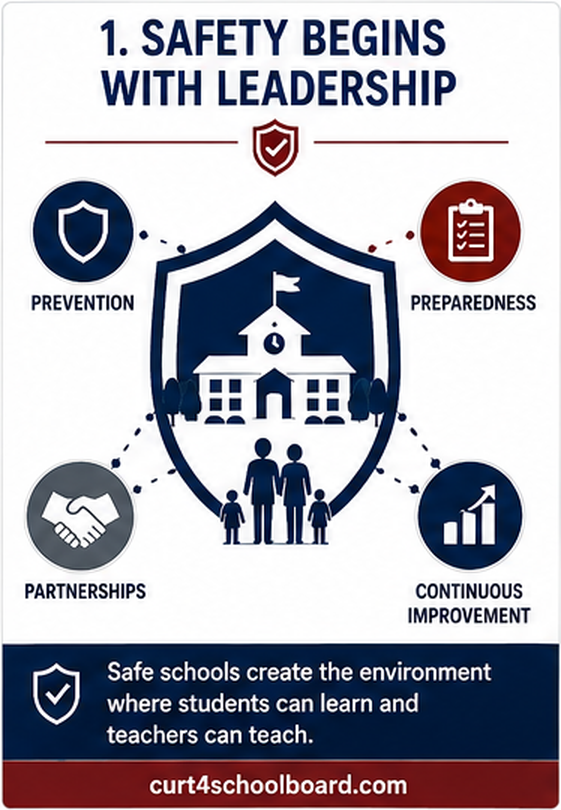
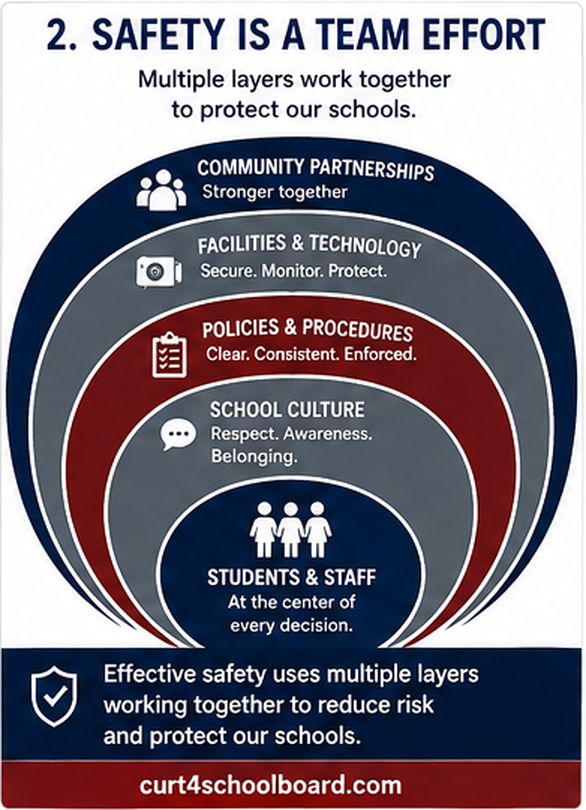
Safety is not a destination; it requires ongoing evaluation, preparation, and leadership. There are additional opportunities to strengthen our policies, procedures, and response plans by making smarter use of the resources we already have and continuing to improve coordination with local law enforcement partners, including those communities where some of our youngest and most vulnerable students attend school.
My professional background provides a unique perspective on school safety and security. As a Chief Information Security Officer, I have spent my career evaluating risks, developing security strategies, and helping organizations protect themselves from emerging threats. At Minneapolis-Saint Paul International Airport, my responsibilities extended beyond information security to include significant aspects of physical security, critical infrastructure protection, access controls, risk assessment, and coordination across security teams and operational partners.
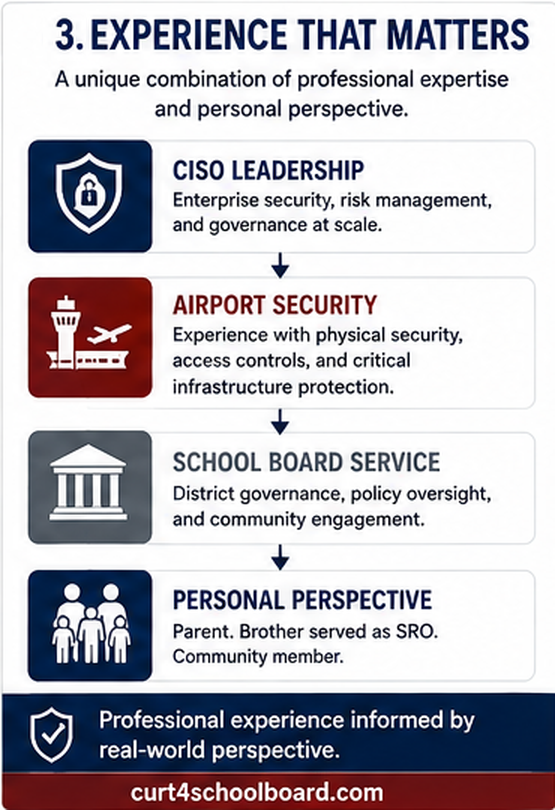
Those experiences have shaped how I approach school safety: identify vulnerabilities, prepare for potential threats, establish clear procedures, and build partnerships that improve response when challenges arise. While schools and airports serve very different purposes, the principles of effective security planning remain the same: understand risks, protect people, and continuously improve.
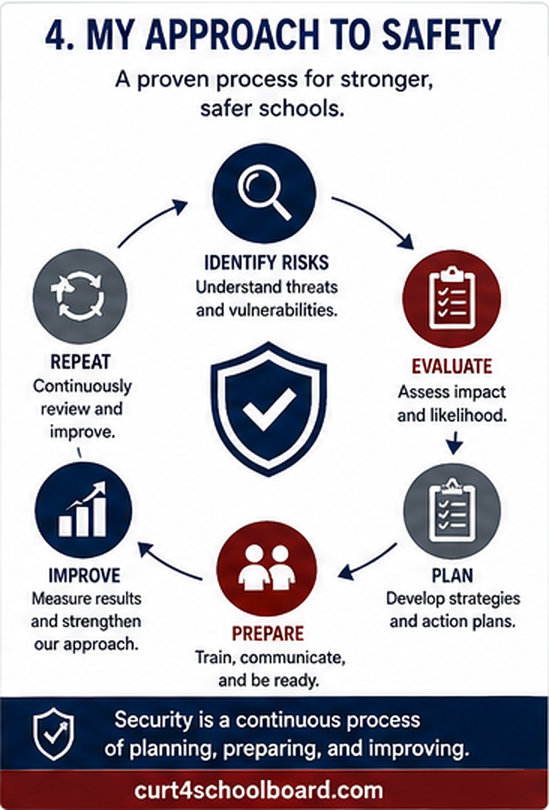
My perspective is also shaped by personal experience. My brother served as a School Resource Officer for several years, giving me additional insight into the challenges faced by school safety professionals and the importance of strong partnerships between schools and law enforcement.
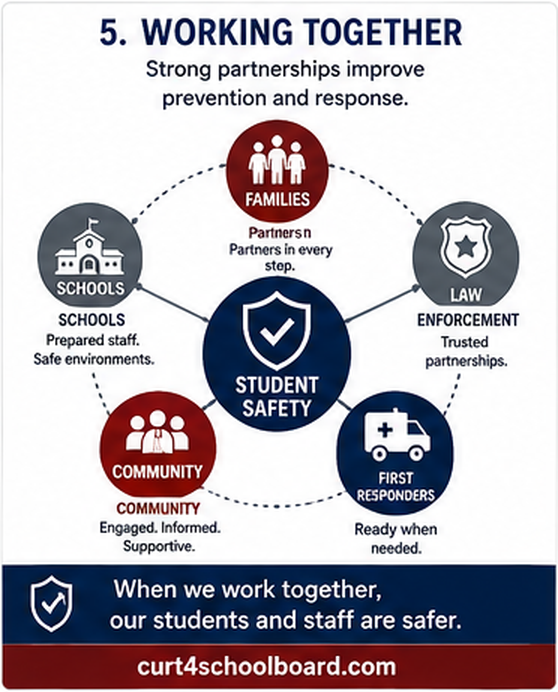
I have reviewed school safety through multiple lenses: as a security professional, a former student, a parent of students across multiple grade levels, and the family member of a first responder serving in our schools. These experiences allow me to bring a practical, comprehensive approach to safety decisions and help ensure that our schools remain places where students and staff can focus on learning in a secure environment.
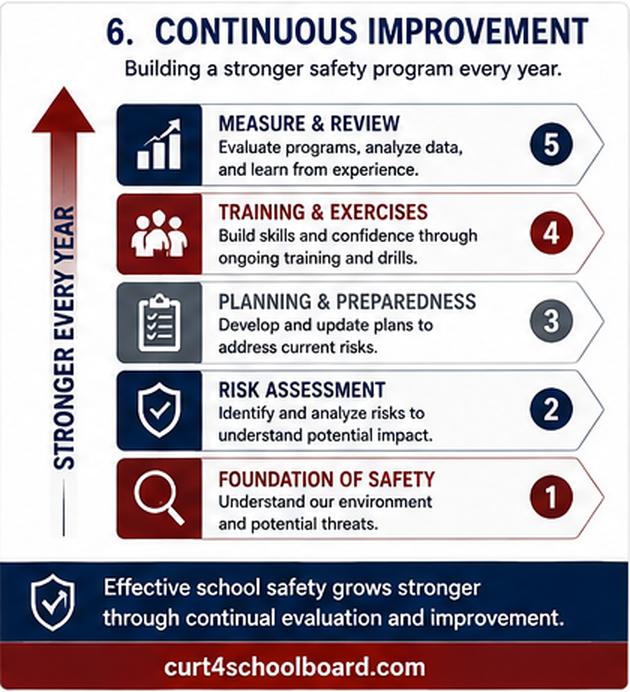
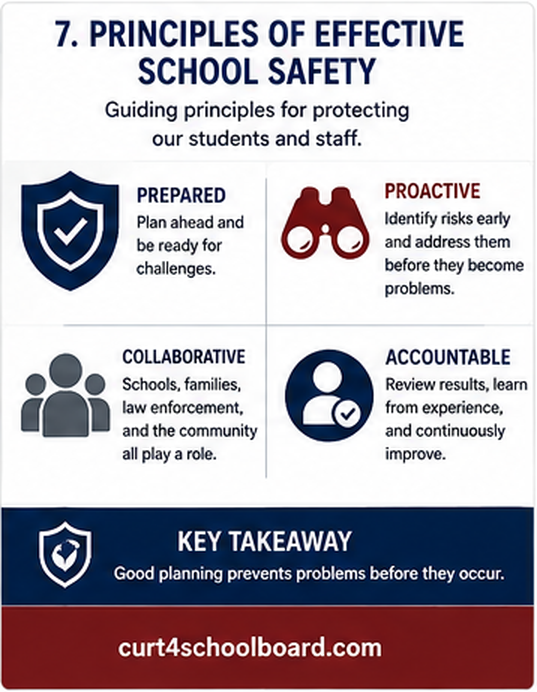
Effective school safety requires more than equipment or policies alone. It requires thoughtful planning, continuous improvement, strong relationships, and leadership committed to protecting our students and staff.
Fiscal responsibility is not about spending less at all costs. It is about spending smarter and leaving the District stronger than you found it.
Leadership Through Fiscal Responsibility
When I was elected to the Board in 2022, I inherited the financial position reflected in the FY2023 Management Report. During my service as Board President, I helped lead the disciplined budgeting and financial oversight that established a dramatically stronger financial foundation.
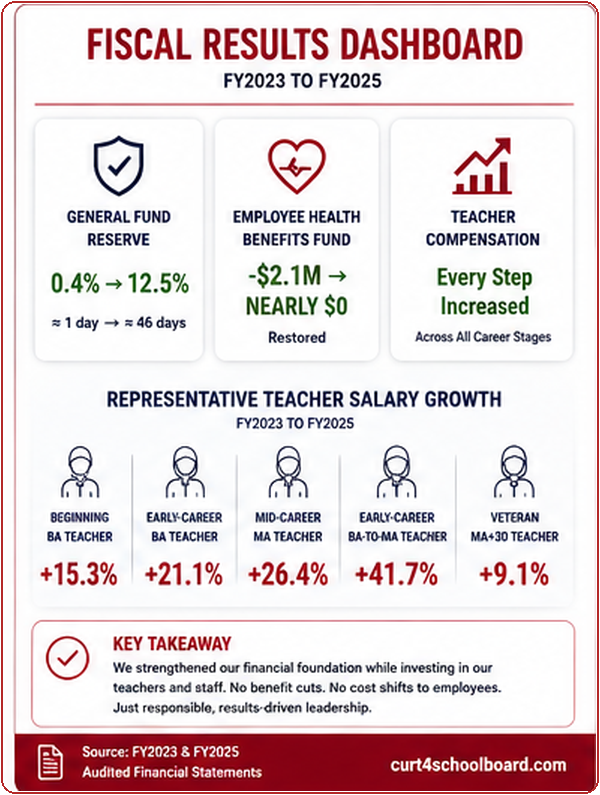
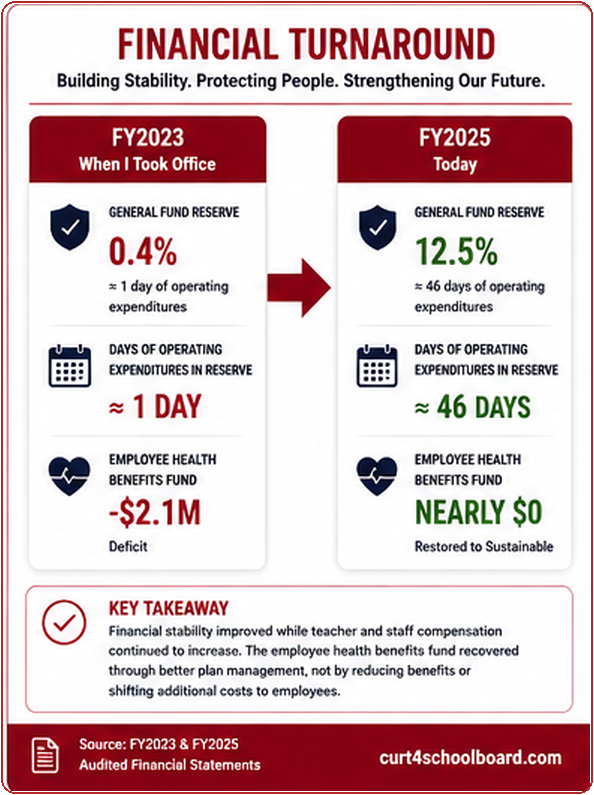
The General Fund reserve improved from 0.4% of annual expenditures in FY2023 to 12.5% in FY2025.
| Measure | FY2023 | FY2025 | Why It Matters |
|---|---|---|---|
| General Fund Expenditures | $89.3 million | $92.1 million | The District continued operating a major public organization while strengthening its financial position. |
| General Fund Balance | $362,375 | $11.6 million | A stronger fund balance provides time and options when unexpected costs occur. |
| General Fund Reserve | 0.4% | 12.5% | The operating cushion improved from approximately 1.5 days to roughly 46 days of annual expenditures. |
| Internal Service Fund * | Negative $2.1 million | ($9,001) | The accumulated deficit was effectively eliminated, improving stability for an important employee benefit. |
| Teacher Compensation | 2023-2024 salary schedule | 2025-2027 negotiated schedules | Representative four-year salary growth ranged from 9.1% for a veteran MA+30 teacher to 41.7% for an early-career teacher completing an approved master's degree. |
* The Internal Service Fund is used primarily to pay employee medical and dental benefits.
Why These Numbers Matter
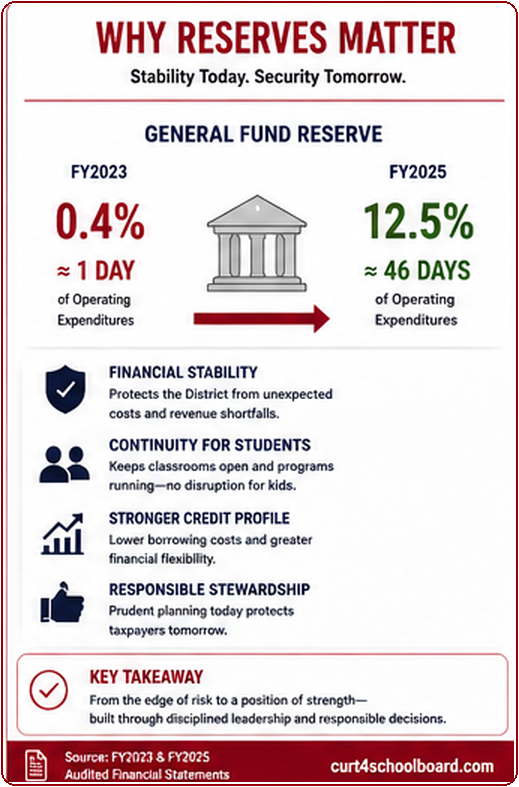
A healthy fund balance is not money sitting idle. It is what allows a school district to weather unexpected expenses, maintain stable operations, protect employee benefits, and avoid financial emergencies.
A reserve of 0.4% represented only about 1 day of annual General Fund expenditures. A 12.5% reserve represents roughly 46 days. That does not eliminate financial risk, but it provides substantially more time to respond thoughtfully instead of relying on abrupt cuts, emergency borrowing, or short-term decisions.
What Fiscal Responsibility Does Not Mean
Cutting programs simply to produce a better number, refusing to invest in employees, postponing necessary decisions, or shifting today's obligations to future taxpayers.
Understanding costs, prioritizing investments, managing risk, protecting reserves, and making decisions the District can sustain over time.
How I Evaluate Major Financial Decisions
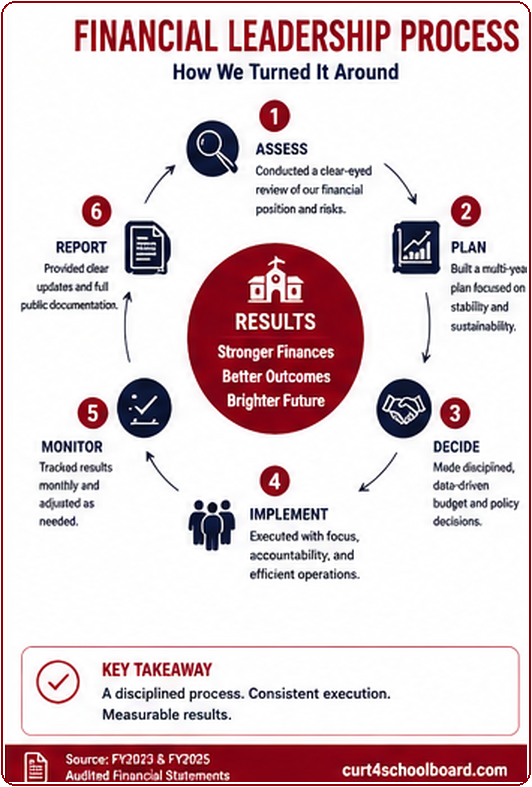
Every major budget decision should answer five questions:
✓ Does it support students and classroom outcomes?
✓ Does it treat employees fairly?
✓ Can the District sustain it beyond the current budget year?
✓ Are the costs, risks, and tradeoffs clearly understood?
✓ Will the decision still look responsible several years from now?
Improving the Employee Health Benefits Fund
The employee health benefits fund tells an important part of the story. At the end of FY2023, it carried a $2.1 million deficit. By the conclusion of FY2025, that deficit had been eliminated, with the fund finishing the year essentially at break-even.
Stabilizing the fund mattered for both employees and taxpayers. Employee medical and dental benefits are a major operating commitment. A persistent deficit creates pressure elsewhere in the budget and increases the risk of abrupt premium, benefit, or contribution changes.
That approach reflects my financial philosophy: before asking employees or taxpayers to contribute more, leaders should first improve how existing resources are managed. Restoring the fund did not eliminate every future health-cost challenge, but it removed a significant inherited deficit and created a much more stable starting point.
What We Did Not Do
The financial recovery was not built on a freeze in employee compensation or a reduction in the value of employee health benefits.
✗ We did not freeze teacher salary schedules.
✗ We did not eliminate the health-plan deficit by reducing employee benefits.
✗ We did not restore the fund by shifting additional benefit costs to employees.
✗ We did not treat the reserve as the only measure of success.
Instead, we improved financial management, negotiated responsible contracts, continued investing in employees, rebuilt reserves, and stabilized the employee health benefits fund.
Investing While Rebuilding
Just as importantly, the District improved its financial position without balancing the budget on the backs of students or employees. During my tenure as Board President, we continued to invest in competitive employee compensation while rebuilding reserves and stabilizing the employee health benefits fund.
The teacher salary schedules provide clear examples of how compensation increased while the District rebuilt its financial position. The examples below track representative teachers from the 2023-2024 schedule through the 2026-2027 schedule.
| Representative Teacher | Starting Point | 2023-2024 | 2026-2027 | Four-Year Gain |
|---|---|---|---|---|
| Beginning BA Teacher | 0 years of experience, BA lane | $42,461 | $48,957 | 15.3% $6,496 |
| Early-Career BA Teacher | 4 years of experience, BA lane | $45,521 | $55,143 | 21.1% $9,622 |
| Mid-Career MA Teacher | 9 years of experience, MA lane | $65,147 | $82,335 | 26.4% $17,188 |
| Early-Career BA-to-MA Teacher | 4 years of experience, master's completed before 2025-2026 | $45,521 | $64,489 | 41.7% $18,968 |
These are representative salary-schedule examples, not a district-wide average. Actual compensation varies by step placement, education lane, longevity, workload, stipends, and other assignments.
These are representative salary-schedule examples, not a district-wide average. They show why a single reported raise percentage rarely tells the full story and, more importantly, they demonstrate that meaningful employee compensation growth occurred at the same time the District restored financial stability.
Responsible contract negotiations were one part of that broader financial strategy. By increasing teacher and staff compensation while strengthening accountability and managing long-term obligations, the District was able to invest in employees without sacrificing its broader financial recovery.
This demonstrates an important principle: fiscal responsibility is not defined by spending the least. It is defined by directing resources deliberately, understanding long-term obligations, and ensuring the organization remains stable enough to serve students and employees through both expected and unexpected challenges.
Interactive Financial Results Explorer
Use the tool below to examine the major financial measures and understand what changed, why it matters, and where the supporting data can be reviewed.
Transparency Through Audited Results
Financial claims should be supported by public evidence. The figures on this page come from the District's audited financial statements and management reports. I encourage residents to review those documents directly.
- Download the FY2025 Management Report
- Download the FY2025 Financial Report
- Download the FY2023 Management Report
- Download the FY2023 Financial Report
Leaving the District Stronger
These improvements did not happen by accident. They reflect deliberate budgeting, careful oversight, and a Board committed to making responsible financial decisions that protect both taxpayers and our schools.
Financial leadership is not measured only by promises to control spending. It is measured by the ability to make difficult decisions, protect essential services, invest in people, and leave the organization stronger than it was before. That is the standard I brought to the Board and the standard I will continue to apply.
Leadership Through Transparency and Trust
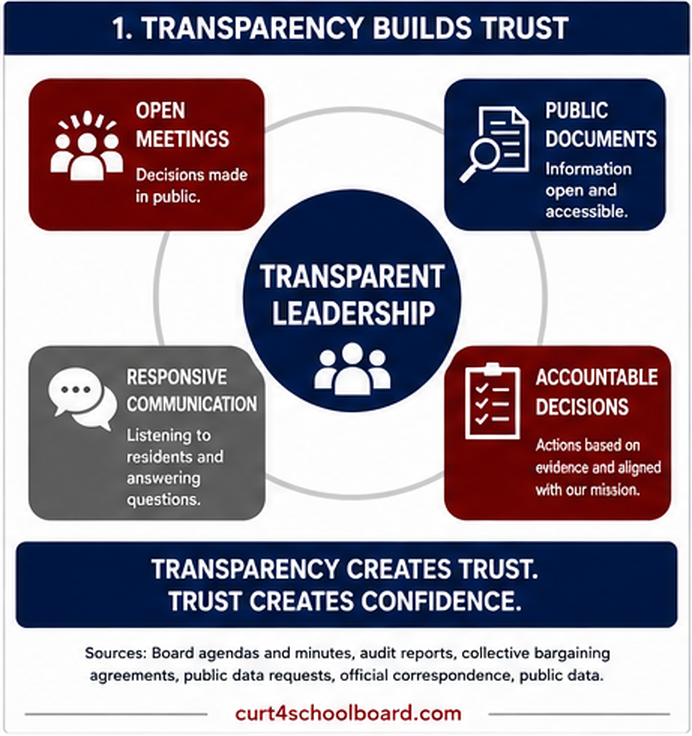
Public trust is built through actions, not just statements about openness. I believe families and community members deserve consistent access to the discussions, decisions, and processes that shape our schools. Leaders should be willing to explain their decisions, show their work, and create systems that allow the public to hold them accountable.
Expanding Public Access and Participation
At the time I took office, families and community members did not have consistent access to Board discussions and decisions. If a parent, student, staff member, or community member could not attend one of the unrecorded meetings in person, they had no opportunity to review the discussion or understand how decisions were made. Public comment also was not available at every meeting, limiting opportunities for community members to address the Board directly.
We expanded opportunities for public participation by ensuring that public comment was available at every Board meeting. Rather than limiting opportunities for community input, we made it a consistent part of every meeting and included those comments in the meeting recordings and livestreams. At a time when some Minnesota school districts were limiting public comment or choosing not to record those portions of meetings, our Board chose a different approach that emphasized openness, accountability, and meaningful public engagement.
In my first meeting as Board President, I established a requirement that all Board meetings be recorded, streamed, and made available to the public. We also made improving the quality of those recordings a deliberate priority, working with district administration to enhance the audio and video experience so meetings would be more accessible and easier for families and community members to follow.
How Transparent Government Should Work
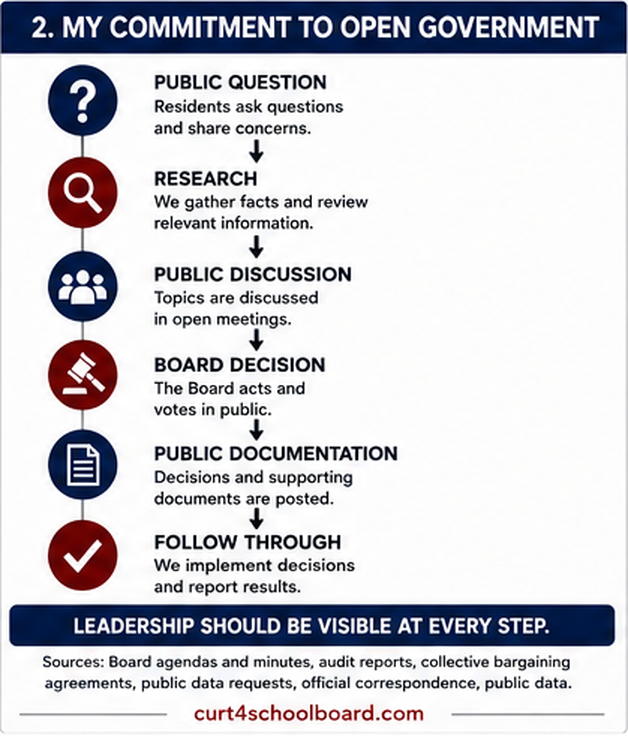
Transparency is more than simply making meetings available online. It requires a consistent commitment to documenting decisions, preserving public records, encouraging community participation, and giving residents the information they need to understand how and why decisions are made. These principles guided many of the governance improvements we implemented during my tenure as Board President.
How We Put Those Principles Into Practice
Those principles were reflected in several practical improvements that strengthened openness and public accountability throughout the District.
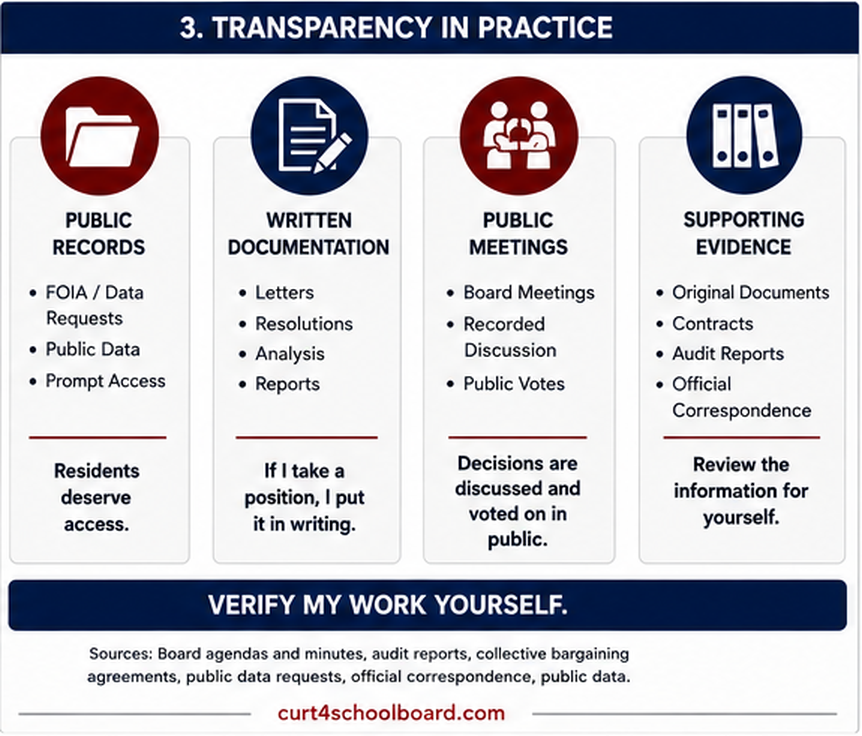
Open Decision-Making and Accountability
Transparency extended beyond routine Board meetings. During the superintendent selection process, we recorded and made available the superintendent interviews so the community could better understand the process and the considerations involved in selecting the district's educational leader.
We also worked to establish clearer expectations for how the Board conducts business. Early in my tenure as Board President, I led the Board in adopting Robert's Rules of Order Newly Revised (RONR) as our parliamentary authority, providing a consistent framework for discussion, motions, debate, and decision-making.
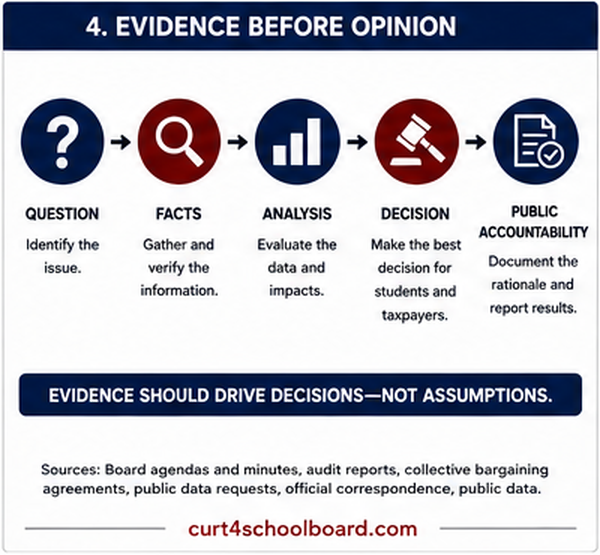
Strengthening Ethics and Governance
These transparency and governance improvements were later formalized through the Board's 1200 and 1300 Series governance policies, a comprehensive modernization effort that I led by authoring the policies in collaboration with fellow Board members and district administration.
This work updated the Board's governance framework to align with current state and federal requirements while creating clearer expectations for Board operations, ethical conduct, Board-administration relationships, and accountability.
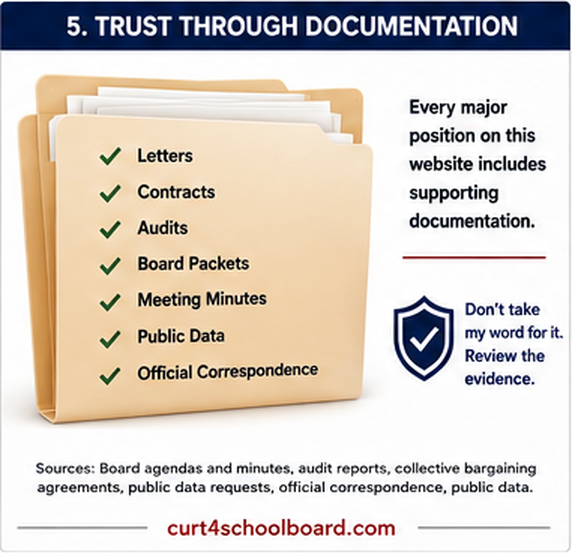
Building Stronger Family Partnerships
Transparency is not only about making information available; it is about creating meaningful opportunities for families to engage with their schools.
Parents and community members are essential partners in student success. By improving access to information, clarifying decision-making processes, and encouraging greater engagement, we strengthen the relationship between our schools and the families we serve.
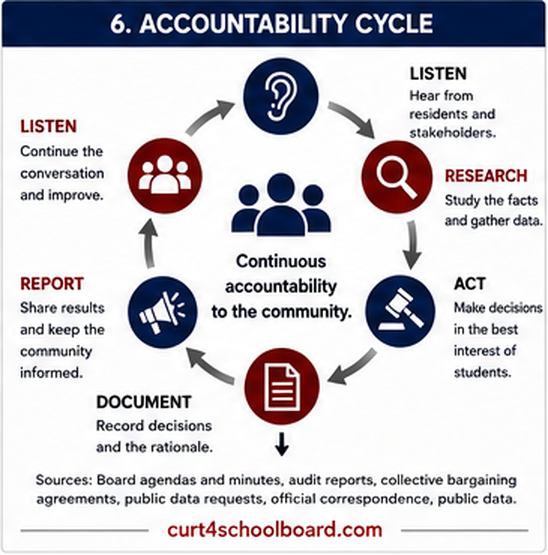
Trust Is Earned Through Verifiable Action
Trust is earned when leaders are willing to show their work. By expanding transparency, creating consistent procedures, strengthening governance standards, and opening more opportunities for community involvement, we have built a stronger foundation of accountability between the Board and the community we serve.
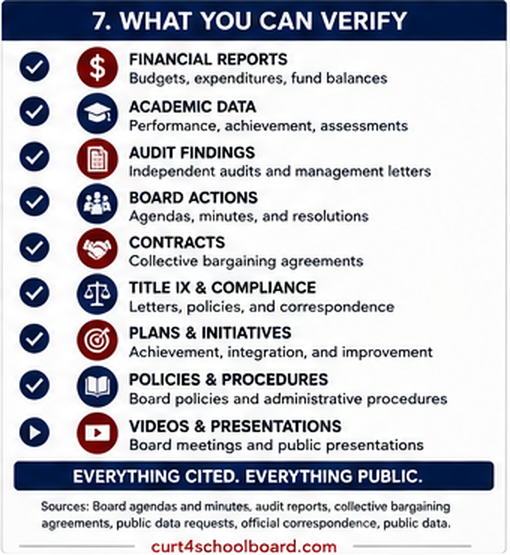
Supporting employees and protecting taxpayers are not competing priorities. Good leadership demands both.
Fiscally Responsible Contracts and Competitive Compensation
| Earlier Approach | Approach as Board President |
|---|---|
| Contract discussions were often viewed as separate transactions. | Contracts were approached through a consistent philosophy of employee investment, accountability, and sustainability. |
| Executive compensation was established largely in advance. | Future executive compensation was connected to goals, evaluation, and Board action. |
| The public commonly saw only a single reported raise percentage. | Teacher compensation is explained openly, including schedule changes, experience steps, and education lanes. |
| Less emphasis was placed on explaining long-term contract liabilities. | Current compensation and future taxpayer obligations were considered together. |
Every employment agreement approved by the School Board represents an investment in people and a long-term commitment of public resources. Strong schools require talented teachers, staff, and leadership. They also require a Board willing to understand the full cost of compensation, ask difficult questions, and negotiate agreements the district can sustain.
My approach is straightforward: invest in employees, expect accountability, and protect taxpayers through thoughtful long-term planning. Negotiations should not be judged by whether one side defeated the other. They should be judged by whether the resulting agreement supports students, respects employees, and remains responsible to the community funding it.
My Negotiation Philosophy
Every negotiation is unique, but the principles I bring to the table remain consistent:
✓ Begin with facts, not assumptions.
✓ Respect the people across the table.
✓ Establish clear priorities and realistic negotiating authority.
✓ Understand both the immediate cost and the long-term financial effect.
✓ Invest in employees because they serve our students.
✓ Protect taxpayers because they make our schools possible.
✓ Pursue durable agreements rather than short-term political victories.
Every Contract Is a Financial Strategy
Employment contracts are among the largest and most consequential financial commitments a school district makes. Salary, insurance, retirement contributions, leave provisions, severance, longevity, and evaluation requirements all create immediate costs and future obligations.
Responsible negotiations require balancing:
✓ Competitive compensation
✓ Recruitment and retention
✓ Employee stability and morale
✓ Long-term liabilities
✓ Budget sustainability
✓ Taxpayer value
That is why I approach contracts as long-term operating decisions, not simply as agreements that solve the issue directly in front of the Board.
How Responsible Negotiations Develop
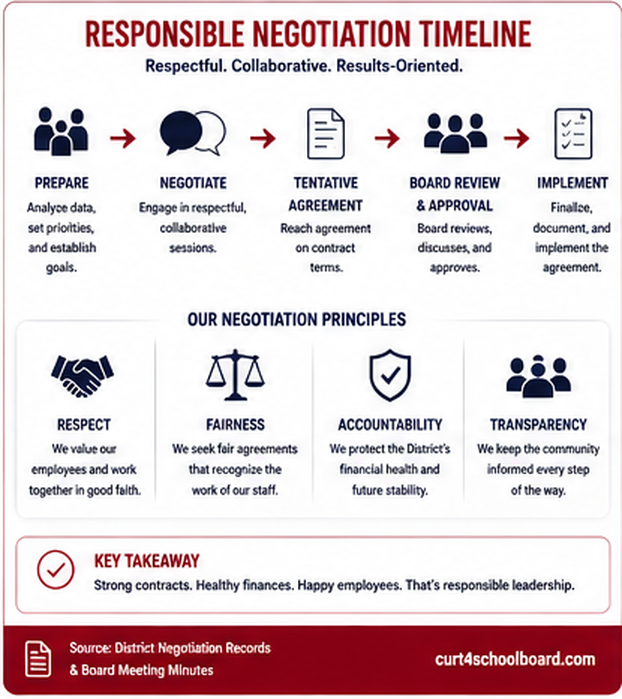
Effective negotiations begin months before a final vote. The Board must understand district finances, recruitment and retention challenges, legal obligations, market conditions, employee priorities, and the long-term effect of each proposal before it establishes bargaining parameters.
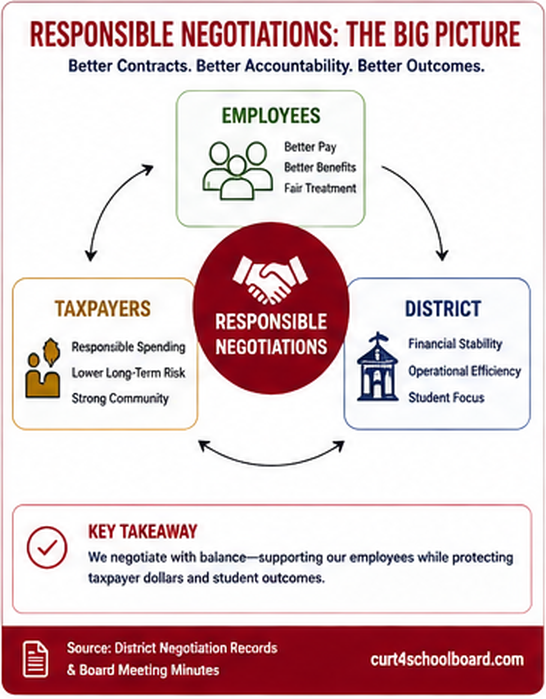
Different Negotiations, One Consistent Philosophy
A collective bargaining agreement covering hundreds of teachers and educators is fundamentally different from an individual executive contract. Responsible leadership means recognizing that difference while applying the same underlying principles.
The priority was competitive compensation, employee retention, professional growth, respectful labor relations, and stability for classrooms and families.
The priority was attracting capable leadership while strengthening evaluation, performance expectations, Board oversight, and management of future financial obligations.
What Responsible Negotiation Does Not Mean
Cutting compensation, freezing salaries, ignoring employee concerns, or shifting avoidable costs to future taxpayers.
Investing strategically, managing liabilities, improving accountability, respecting employees, and protecting the district's long-term financial position.
Increasing Teacher and Staff Compensation
Teachers and other educators are central to student success. Competitive compensation helps the district recruit talented professionals, retain experience in our schools, and reduce the disruption created by recurring vacancies and turnover. During the most recent negotiations, the Board and the Forest Lake Education Association reached a two-year agreement that continued annual step advancement and increased the salary schedules for both contract years.
The agreement also addressed compensation and working conditions beyond the classroom salary schedule, including provisions affecting preschool educators, early childhood and adult basic education staff, year-round service providers, extracurricular assignments, professional development, and retirement contributions.
Why Retention Is a Financial Issue Too
Competitive compensation is not simply an expense. Recruiting, hiring, onboarding, and supporting new employees also carry real costs. When experienced educators remain in Forest Lake, students benefit from instructional continuity, schools retain institutional knowledge, and the district reduces the recurring disruption associated with vacancies and turnover.
A reported contract increase and an individual teacher's actual salary increase are not always the same number. Teacher pay can grow through several components:
✓ Changes to the negotiated salary schedule
✓ Step advancement for an additional year of experience
✓ Lane advancement for additional approved education
Because teachers begin at different steps and lanes, their year-over-year increases vary. The examples below follow actual Forest Lake salary schedules. Four examples assume normal step advancement without a lane change. A fifth example shows a teacher who begins on the BA lane, completes an approved master's degree, and moves to the MA lane during the four-year period.
Actual Salary Growth Across Four Contract Years
The following examples track representative teachers from the 2023-2024 salary schedule through the 2026-2027 schedule. Starting experience is shown as of the beginning of the 2023-2024 school year. These are examples from the schedules, not an average increase for all employees.
| Example | 2023-24 | 2024-25 | 2025-26 | 2026-27 | Four-Year Gain |
|---|---|---|---|---|---|
|
Beginning Teacher 0 years | BA Step movement, no lane change |
$42,461 | $45,018 +6.0% |
$46,991 +4.4% |
$48,957 +4.2% |
+15.3% $6,496 |
|
Early-Career Teacher 4 years | BA Step movement, no lane change |
$45,521 | $47,861 +5.1% |
$51,122 +6.8% |
$55,143 +7.9% |
+21.1% $9,622 |
|
BA-to-MA Teacher 4 years | BA ★ Largest gain shown Master's completed before 2025-26 |
$45,521 | $47,861 +5.1% |
$60,196 +25.8% |
$64,489 +7.1% |
+41.7% $18,968 |
|
Mid-Career Teacher 9 years | MA Step movement, no lane change |
$65,147 | $70,174 +7.7% |
$76,860 +9.5% |
$82,335 +7.1% |
+26.4% $17,188 |
|
Veteran Teacher 20 years | MA+30 Includes applicable longevity |
$85,625 | $88,501 +3.4% |
$90,967 +2.8% |
$93,428 +2.7% |
+9.1% $7,803 |
Methodology: The beginning, early-career, and mid-career examples follow normal annual step movement within a constant education lane. The BA-to-MA example follows the same starting point as the early-career example but assumes the teacher completes an approved master's degree before the 2025-2026 school year and moves from the BA lane to the MA lane. The veteran example uses the MA+30 salary and applicable cumulative longevity amounts for a teacher beginning with 20 years of district service. Actual pay varies by placement, district service, education lane, eligibility for longevity, workload, stipends, and other assignments.
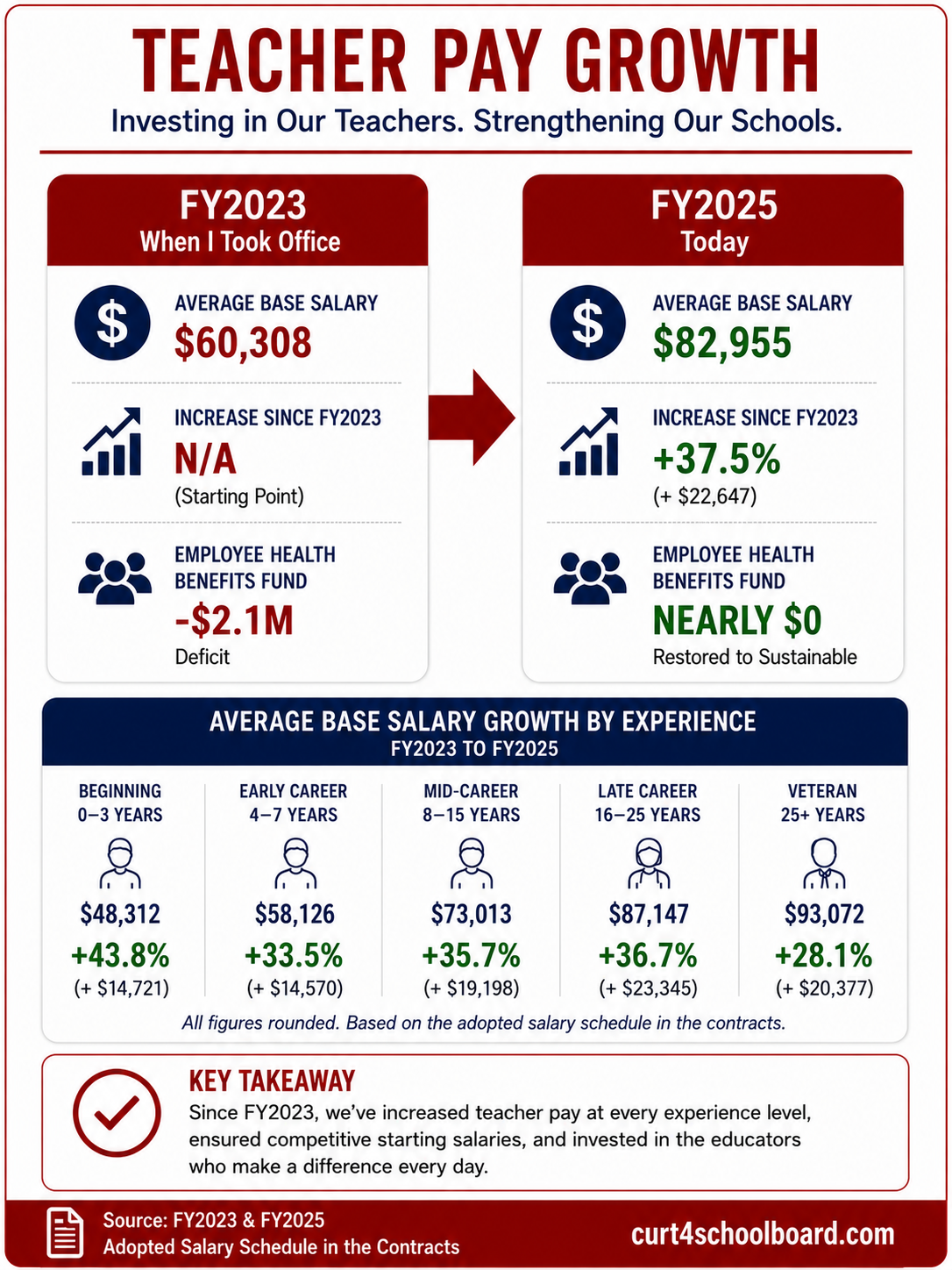
The examples demonstrate why a single percentage rarely tells the whole story. A veteran at the upper end of the schedule primarily receives negotiated schedule increases and longevity compensation. Earlier and mid-career teachers may receive both a schedule increase and step movement. Teachers who complete additional approved education may also move to a higher lane. In this representative group, the largest gain shown is the BA-to-MA example, which grows from $45,521 to $64,489, an increase of approximately 41.7% over four contract years. That example combines negotiated schedule changes, normal step movement, and completion of an approved master's degree.
Explore Compensation Across District Contracts
Compensation structures differ across employee groups. Teachers use salary steps and education lanes. Bus drivers, bus aides, and educational paraprofessionals use hourly schedules. Principals use position-based annual salaries with experience increments. Directors and the superintendent use annual compensation established by their respective agreements.
Select an employee group below to explore the compensation provisions currently available from the published agreements. The tool adapts to each contract and allows visitors to review individual rates, full schedules, and multi-year comparisons where the source documents support them.
Important: This is an educational comparison based on the published agreements. Actual placement and compensation are governed by the applicable contract and may be affected by eligibility for step movement, prior-experience placement, hours or days worked, part-time status, education or licensure requirements, experience increments, longevity, stipends, additional assignments, performance review, Board action, or other contract provisions.
Strengthening Executive Accountability
The superintendent contract required a different balance. Competitive compensation was necessary to attract qualified leadership, but an executive agreement also needed clearer accountability to the elected Board and better control of long-term liabilities.
As Board President, I authored the initial draft and participated directly in the negotiations that produced the final agreement. The Board's objective was to remain competitive while creating clearer accountability and reducing unnecessary long-term exposure.
Annual written performance evaluation, Board-approved professional goals, two formal Board-superintendent relationship reviews each year, and future salary decisions tied to performance and Board action.
Reduced annual severance accrual, a lower maximum severance accumulation, tighter eligibility for district-paid retirement insurance, a shorter maximum insurance period, and a 260-day daily-rate calculation that reduces the value of several future payouts.
A two-year contract rather than three years, clearer renewal timelines, more frequent Board oversight, and better-defined expectations between the Board and superintendent.
The agreement also enhanced selected benefits to remain competitive, including retirement matching, life insurance, and professional development support. Fiscal responsibility does not mean offering the lowest possible compensation. It means understanding the total package, strengthening accountability, and making deliberate choices about both current costs and future obligations.
My Role in the Most Recent Agreements
School Board negotiations are collaborative, and no single Board member acts alone. As Board President, my role included helping establish negotiating priorities, participating directly in negotiations, reviewing financial impacts, working with legal counsel and district administration, drafting the initial superintendent agreement, helping build Board consensus, and voting on the final agreements.
The result reflects the principle printed on my campaign materials: we can negotiate fiscally responsible contracts while increasing teacher and staff compensation. Supporting employees and protecting taxpayers are not mutually exclusive. Strong leadership requires doing both.
The Results Matter
Leadership should be judged by outcomes. The agreements reached during my tenure did not occur in isolation. They were part of a broader effort to improve employee compensation, strengthen executive accountability, and restore the district's financial stability.
| Measure | Earlier Position | Position During My Tenure |
|---|---|---|
| General Fund Reserve | 0.4% | 12.5% |
| General Fund Balance | $362,375 | $11.6 million |
| Employee Health Benefits Fund | Negative $2.1 million | Essentially break-even |
| Teacher and Staff Compensation | Prior contract structure | Continued investment and meaningful increases |
| Superintendent Accountability | Fewer formal requirements | Goals, written evaluation, action plan, and recurring reviews |
These results demonstrate an important principle: investing in employees and protecting taxpayers are not competing goals. The district rebuilt its reserve position and stabilized the employee health benefits fund while continuing to increase employee compensation.
Interactive Contract Explorer
The summaries below help readers understand the most significant differences without requiring them to read every page first. Each topic explains what changed, why it matters, and where to find the supporting agreement.
Public Documents and Supporting Evidence
These agreements are public commitments made on behalf of the community. I encourage residents to review the source documents and evaluate the results directly.
- 2023-2025 Forest Lake Education Association Agreement
- 2025-2027 Forest Lake Education Association Agreement
- 2022-2024 Bus Drivers and Bus Aides Agreement
- 2024-2026 Bus Drivers and Bus Aides Agreement
- 2022-2024 Educational Paraprofessionals Agreement
- 2024-2026 Educational Paraprofessionals Agreement
- 2023-2025 Principals and Assistant Principals Agreement
- 2025-2027 Principals and Assistant Principals Agreement
- 2023-2025 District Directors Agreement
- 2025-2027 District Directors Agreement - Board-Adopted Strike-Through Version
- 2023-2026 Superintendent Contract
- 2026-2028 Superintendent Contract
- FY2023 Management Report
- FY2025 Management Report
Investing Today Without Ignoring Tomorrow
Our schools succeed when talented people choose to build their careers here. Our community succeeds when those investments are made honestly and sustainably. That is the standard I brought to these negotiations and the standard I will continue to apply: competitive compensation, clear accountability, respectful collaboration, and responsible stewardship of every public dollar.
F-A-Q
Learn More About Mike & Sean
School Board elections are important decisions for our community. Every voter should have the opportunity to hear from candidates directly, understand their priorities, and consider the experience and perspective each person would bring to the role.
Mike Belz and Sean Thomas are both seeking election to the School Board and have shared information about their backgrounds, priorities, and vision for the district through their campaign websites.
- Mike Belz: mikebelz4fl.com
- Sean Thomas: seanthomas4fl.com
A Choice About the Future Direction of Our Schools
I believe this election represents a choice about the future direction of our district. Voters have the opportunity to decide whether we continue the work of improving transparency, strengthening governance, prioritizing academic achievement, and exercising responsible stewardship of taxpayer resources, or whether we move in a different direction.
Over the past several years, our district has faced significant challenges, including financial pressures, declining enrollment, and the need to improve student outcomes. Addressing those challenges requires leaders who are willing to make difficult decisions, establish clear priorities, and remain focused on long-term success.
I am committed to continuing the work of building a stronger school district by focusing on student achievement, fiscal responsibility, transparency in decision-making, and protecting opportunities for every student. I believe our community deserves a Board that is focused on results, accountability, and preparing our schools for a stronger future.
I encourage every voter to compare the candidates' experience, priorities, and approach to leadership before casting their ballot. The future of our schools depends on informed participation from our entire community.
Maintaining Independence as a Board Member
I am proud to say that I am not financially supported by any political parties, political action committees (PACs), unions, or similar entities. I believe this independence is important because school board members must be able to make decisions based solely on what is best for students and the community.
I am open to accepting financial support directly from community members on a case-by-case basis. However, what I value most from this community is not a campaign contribution; it is your trust, your support, and ultimately your vote.
Avoiding Conflicts of Interest
In my opinion, even the perception of a conflict of interest should be avoided by school board members. The public deserves confidence that board decisions are made independently and are not influenced by outside obligations or relationships.
For that reason, I believe board members should not be employed by the district they serve. While Minnesota law does allow limited employment of board members under certain circumstances, I believe maintaining a clear separation between the governing body and district employees is the better approach.
The same principle applies to employment with neighboring school districts or other organizations that could create divided loyalties or competing interests. Board members are elected to provide oversight, accountability, and leadership for our district, and they should remain fully independent from organizations that may be affected by board decisions.
Transparency and Accountability Matter
I believe potential board members should fully disclose any current or prior relationships with political parties, unions, advocacy organizations, or other entities that could create a perceived conflict of interest.
School board members make decisions involving budgets, contracts, and district priorities. Because of that responsibility, I believe they should avoid accepting campaign contributions from organizations that may seek contracts, influence, or other decisions from the district.
Members of our current school board (and other individuals in this race) have accepted significant contributions from organizations such as IBWE Local 110 Electricians, Local 322 Carpenters, Local 68 Carpenters, North Central State Council of Carpenters, Forest Lake Education Association (FLEA, our local teacher's union), and others. These organizations have the right to participate in the political process, but voters deserve transparency about potential relationships that could affect future decisions.
When organizations that may be impacted by district decisions contribute to campaigns, the community deserves clear answers about how board members will maintain independence and put the interests of students and taxpayers first.
Keeping the Focus Where It Belongs
School board members should never be beholden to an outside entity, whether that is an employer, political party, PAC, union, or another organization. Their responsibility is to the students, families, educators, and taxpayers they represent.
By choosing not to accept contributions from these types of entities, I am able to keep my focus where it belongs: on student achievement, responsible stewardship of taxpayer resources, transparency in decision-making, and building a stronger future for our schools.
Parents as Partners in Education
Parents are the primary educators for their children, and it is critical that our school board keep that responsibility in mind when creating policies and procedures. Schools exist to support students and families, and that requires a strong partnership between parents, educators, administrators, and the community.
Our schools should welcome constructive parental involvement and create opportunities for parents to engage with their child's education. Parents should have opportunities to provide feedback on curriculum, participate in school activities, volunteer in our schools, observe their students in appropriate settings, and attend special events that bring families and the school community together.
Transparency and Communication Matter
Parents deserve clear communication about what their children are learning, how decisions are being made, and how school policies affect their families. A transparent school district builds trust by keeping families informed and providing meaningful opportunities for input.
That does not mean every decision will always reflect the preference of every individual family, but parents should know that their voices are valued and that their concerns are taken seriously.
Supporting Student Success
Constructive parental involvement is an asset to our schools and our district. When parents and educators work together with a shared focus on student success, students benefit from stronger support both inside and outside the classroom.
As a school board member, I would support policies and practices that encourage family engagement, strengthen communication, and recognize parents as important partners in preparing every student for success.
Independence and Representation
I believe school board members are elected by the entire community and have a responsibility to represent students, families, educators, taxpayers, and the broader community as a whole. Employee associations play an important role in advocating for their members, just as other organizations represent the interests of their constituencies. A strong school district requires a productive relationship between the Board and employee groups, while also respecting that each group has different responsibilities and obligations.
For that reason, I believe school board members should maintain clear boundaries and independence from organizations that may participate in negotiations or other formal processes with the district. This principle applies regardless of whether that relationship comes through an endorsement, leadership position, or other formal affiliation.
Public confidence in elected officials depends not only on the decisions they make, but also on the perception that they are able to make those decisions independently. When a Board member has a formal leadership role within an organization that may advocate on issues coming before the Board, voters deserve to consider whether that relationship could create questions about independence or the ability to represent the entire community.
This is not a question of whether someone respects or values educators. Strong relationships with teachers and staff are essential to a successful school district. It is about ensuring that school board members are able to approach every decision with the independence and objectivity expected of someone elected to represent the entire community.
Collective Bargaining and Public Trust
The collective bargaining process is one example where independent representation matters. Both the school board and employee associations have important responsibilities during negotiations. The Board must advocate for students, families, taxpayers, and the long-term sustainability of the district, while employee associations advocate for their members.
I believe school board members should enter those conversations without obligations that could create questions about their independence. This does not mean avoiding relationships with educators or employee groups; in fact, collaboration and respect are essential. It means ensuring that all parties can participate with confidence that each representative is acting independently and in the best interest of those they were elected to serve.
Respect for Our Educators
My decision not to seek or accept a FLEA endorsement is not a reflection of a lack of respect for our educators or the important work they do. In fact, it comes from a deep respect for the role educators play in our schools and the importance of preserving a healthy working relationship between the Board and employee groups.
I believe the strongest relationships are built when everyone can engage honestly, respectfully, and independently. By maintaining clear roles and expectations, we create the foundation for productive conversations, stronger partnerships, and better outcomes for students and the entire school community.